
A special congratulations to Franziska Alt for driving this work forward with outstanding dedication and expertise. 👏
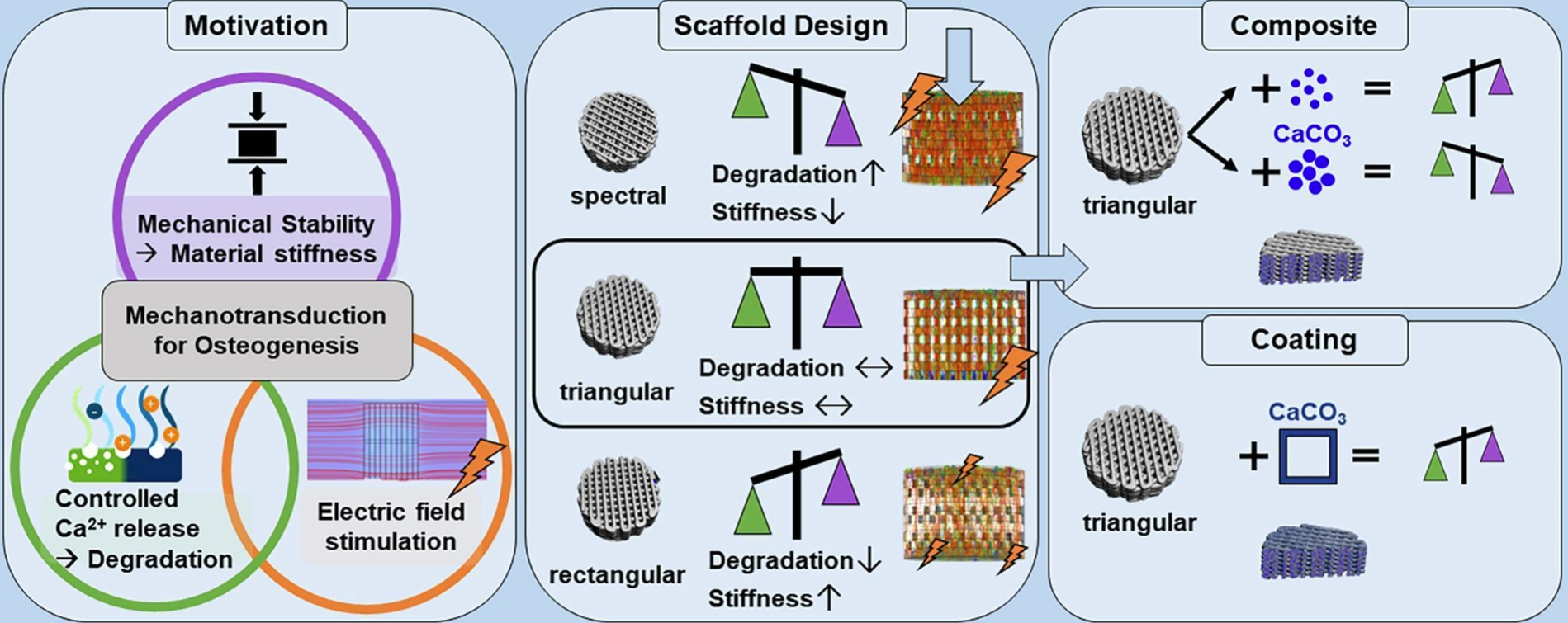
A key contribution from Dr.-Ing. Revathi Apalli and Dr.-Ing. Kirankumar Sriperumbudur, Dr-Ing was the development of an in silico framework that reveals how scaffold architecture and material properties influence electric field distribution within 3D-printed bone scaffolds.
By integrating computational modeling with experimental validation, we show that scaffold design involves critical trade-offs between mechanical stability, degradation behavior, and electrical stimulation. Our simulations demonstrate that scaffold geometry actively shapes the electrical microenvironment experienced by cells, providing valuable insights for the rational design of next-generation biomaterials.
This study highlights how computational tools can accelerate the optimization of tissue-engineering scaffolds and reduce reliance on trial-and-error approaches.
Many thanks to all collaborators for the excellent teamwork at Technische Universität Dresden and to the Deutsche Forschungsgemeinschaft (DFG) - German Research Foundation for supporting both our project and the Collaborative Research Center SFB 1270 ELAINE. We look forward to advancing predictive and data-driven approaches in regenerative medicine.
View PDF
Team: Franziska Alt, Dr.-Ing. Revathi Appali , Dr.-Ing. Kirankumar Sriperumbudur, Henning Bathel, Poh Soo Lee, Holger Neubert , Ursula van Rienen, Benjamin Kruppke